
By Morgan Helmling, BHSc (Naturopathy), Living Holistic Health — preconception care is the work both partners can do in the three months before trying for a baby, and this post is the map for it.
Whether you’re about to start trying for a baby or you’ve been trying for a while, I’m really glad you’re here.
Planning a pregnancy can feel exciting and overwhelming in the same breath. So I want to give you something calmer: a clear, honest plan for the two of you.
Here’s the heart of it. A baby begins as one egg and one sperm. Sperm take about 70 days to make. Meanwhile, the follicle that releases an egg begins its final growth phase around 85 days before ovulation. That three-month window is where preconception care does its work.
This topic is personal for me, because I’ve been through my own fertility journey. That’s a big part of why I do this work, and why this series is written for both of you. If you’re in the thick of it right now, please know you’re not alone.
This post opens our Preconception Essentials series, and each deeper topic has a post of its own.
The short version:
- Start about three months before trying, together, because eggs and sperm take roughly that long to develop.
- Eat a Mediterranean-style diet, and cut out alcohol and smoking, as Australian guidance advises.
- Folic acid and iodine are the two nutrients Australian guidance recommends before conception. Ask your GP which amount suits you.
- See your GP after 12 months of trying, or after six months if you’re 35 or older.

What Is Preconception Care, and Why Do Both Partners Matter?
Preconception care is the health work a couple does before trying to conceive. It covers food, alcohol, smoking, sleep, weight, a few key nutrients and any existing health conditions. Both partners matter because a pregnancy starts with one egg and one sperm. Each is shaped by the health of the person making it in the months beforehand.
Advice about planning a pregnancy has tended to land on women alone. However, Australian men’s health guidance makes an important point. In about half of couples who struggle to conceive naturally, the problem lies with the male partner. Sperm also respond to many of the same everyday changes. That’s why this series gives sperm health a full post of its own.
So when I talk about preconception care, I mean a plan for two. It isn’t a list of rules for one person to carry. In practice, changes are also easier to keep when you’re cooking the same meals and keeping the same bedtime.
Does Preconception Care Make a Difference?
Honestly, the evidence is mixed, and I think you deserve to know that. Pooled trials of lifestyle programmes show little overall difference in pregnancy rates. However, longer, structured programmes look more promising, and they reliably improve weight and blood glucose. Steady, supported change over months seems to matter more than a one-off list of advice.
According to PubMed, a 2026 review in Human Reproduction Update pooled 24 randomised trials involving 7,795 women planning a pregnancy. Overall, lifestyle programmes made no clear difference to clinical pregnancy or live birth. Programmes delivered over ten or more sessions, however, were linked with higher odds of clinical pregnancy (odds ratio 2.17). The authors call that an exploratory finding, to be read with caution. The programmes did lower weight, by about 3.9 kg on average, and fasting blood glucose.
Similarly, a 2021 Cochrane review looked at preconception advice for people with infertility. Advice covering several topics at once made little or no difference to live births, although the evidence was low quality. Notably, only one of its seven trials included male partners.
What I take from this is simple. A leaflet on its own probably isn’t enough. Rather, the research favours sustained, supported change over a single conversation.
How Early Should You Start Preconception Care?
Around three months before you start trying is a sensible minimum. That’s roughly how long sperm take to develop and how long an egg’s follicle takes to complete its final growth. Folic acid and iodine have their own timing, though: Australian advice is to start both at least one month before conception.
If you’ve already started trying, please don’t be alarmed. Everything in this post still applies from today. Meanwhile, if you’re further out, a longer runway gives you time to change habits gently rather than all at once.
Age matters too, and it’s kinder to say so plainly. According to Your Fertility, the Australian Government-funded fertility education program, women’s fertility starts to decline after 30 and more noticeably after 35. Men’s fertility also declines with age, although the effect is smaller. Therefore, if you’re ready to start, sooner is generally better than later.
What Should You Eat When Planning a Pregnancy?
There’s no single fertility diet. The best-supported pattern is a Mediterranean-style way of eating: plenty of vegetables, fruit, legumes, wholegrains, nuts, olive oil and fish, with fewer ultra-processed foods. Australian fertility guidance names the Mediterranean diet as a good example for anyone planning a pregnancy, and it suits both partners.
The research behind it is encouraging but not yet strong. According to PubMed, a 2022 review in Advances in Nutrition found that closer adherence to a Mediterranean pattern was linked with nearly double the odds of live birth across two IVF studies (odds ratio 1.98, 355 people). All 13 studies in that review carried a moderate to high risk of bias, though, and results across different diets were inconsistent.
Likewise, a study from the Netherlands followed 199 couples having their first IVF cycle. Each one-point rise in the woman’s score for following national dietary guidelines was linked with 65% higher odds of an ongoing pregnancy. Both studies involved IVF, so they don’t prove the same holds for natural conception. Still, the direction is consistent, and this way of eating supports long-term health either way.
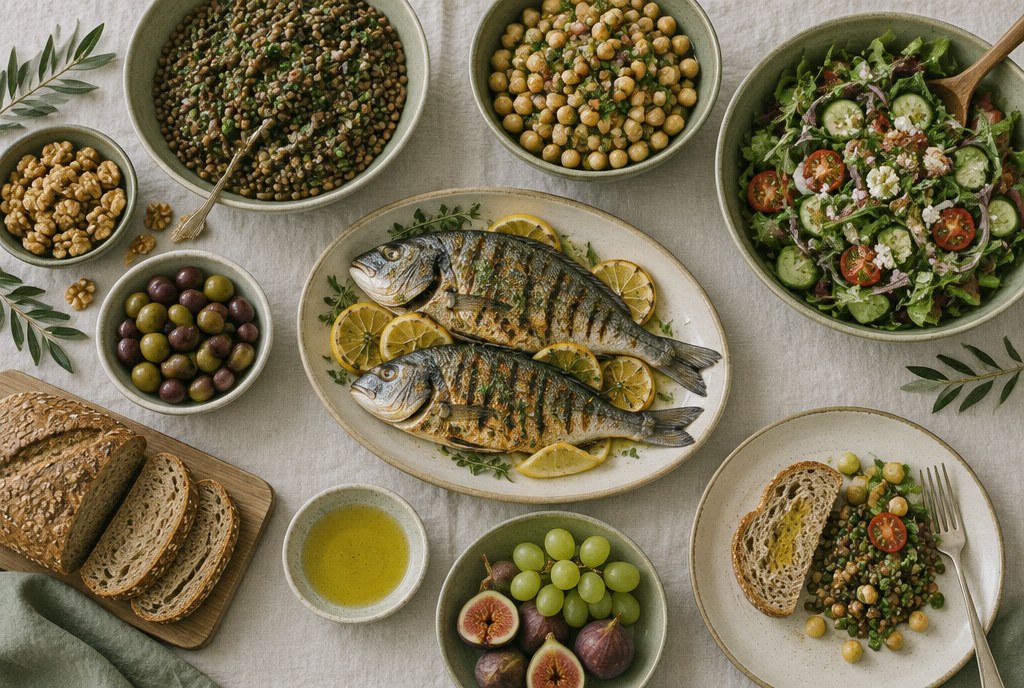
In practice, I’d start with a few steady changes:
- build most meals around vegetables and a palm-sized serve of protein;
- swap refined grains for wholegrains and legumes a few times a week;
- use olive oil as your main cooking fat;
- include fish two or three times a week, choosing lower-mercury varieties, as Food Standards Australia New Zealand advises for anyone planning a pregnancy;
- keep takeaway and ultra-processed snacks for occasionally, not daily.
If blood sugar, weight or PMOS is part of your picture, our post on the insulin resistance diet goes further into what the evidence supports.
Which Preconception Nutrients Have Real Evidence?
Two have strong evidence and clear Australian guidance. Folic acid lowers the risk of neural tube defects, and a baby needs iodine for brain and nervous system development. Vitamin D is the one people ask about most, and its evidence is genuinely mixed. Beyond those, more isn’t automatically better, so check with your practitioner before adding anything.
Folic acid and neural tube defects
According to PubMed, a 2015 Cochrane review looked at folic acid taken around conception. It cut the risk of neural tube defects, such as spina bifida, by about 69% (risk ratio 0.31, high-quality evidence). Australian guidance recommends a daily folic acid supplement starting at least one month before conception. The right amount isn’t the same for everyone, so ask your GP or pharmacist which applies to you.
If you’ve come across MTHFR and wondered whether it changes the folate picture, our post on MTHFR in pregnancy walks through what the latest research shows.
Iodine and the NHMRC guidance
The National Health and Medical Research Council recommends that women who are planning a pregnancy, pregnant or breastfeeding take a daily iodine supplement. The body uses iodine to make hormones the baby needs for normal brain and nervous system development. Importantly, anyone with a thyroid condition should check with their GP first. The NHMRC also advises against kelp or seaweed supplements, because their iodine content varies.
Vitamin D is genuinely mixed
Vitamin D is where the research disagrees with itself. According to PubMed, a 2018 study followed 1,191 women with one or two previous pregnancy losses. Those with sufficient vitamin D before conception (75 nmol/L or above) were more likely to have a live birth (risk ratio 1.15). In contrast, a 2020 meta-analysis of women having IVF found no clear link with pregnancy or live birth. That held once its results were tested for robustness.
So it’s reasonable to ask your GP whether checking your vitamin D level makes sense for you. For a closer look at what prenatal supplements can and can’t do, see Prenatal Supplements: What the Evidence Really Shows.
General information only, not individual medical advice. Always discuss supplements and herbal medicines with your treating practitioner.
What Should You Cut Back On Before Conception?
Alcohol, smoking and recreational drugs top the list, for both partners. Australian guidelines advise women who are planning a pregnancy not to drink at all. Fertility guidance also suggests keeping caffeine to around 200 mg a day, about two cups of coffee. Sleep deserves attention too, along with everyday chemical exposures where they’re easy to reduce.
Alcohol and smoking
According to PubMed, a 2017 meta-analysis pooled 19 studies and 98,657 women. Women who drank alcohol had 13% lower fecundability, the chance of conceiving in any given cycle (relative risk 0.87). Even light drinking was linked with a smaller reduction. That’s one reason Australia’s alcohol guidelines advise women who are planning a pregnancy not to drink. For men, heavy and binge drinking are the main concern.
Smoking affects both partners as well. Your Fertility notes it can lengthen the time it takes to conceive and affect egg quality. For men, heavy smokers can produce up to 20% fewer sperm. If either of you smokes, stopping is one of the clearest changes you can make, and your GP can help.
Sleep and everyday chemicals
Sleep is easy to overlook. According to PubMed, a 2019 North American study followed 6,873 women trying to conceive. Those who had trouble sleeping more than half the time had 13% lower fecundability. Shorter sleep showed a weaker link, and shift work showed none. A regular bedtime and a wind-down routine are therefore worth building into your plan.
Finally, some chemicals in everyday products can act on hormones. Australian fertility guidance suggests reducing exposure at home and at work where you can. Simple swaps, such as reheating food in glass rather than plastic, are a reasonable place to start. Our post on xenoestrogens explains the background, and the last part of this series looks at the evidence on endocrine disruptors and fertility.
How Long Does It Usually Take to Get Pregnant?
For most couples, less time than the worry suggests. One German study followed couples who timed sex to the fertile window. Of those, 38% conceived in the first cycle, 68% within three, 81% within six and 92% within a year. So a few months without a positive test is common, and on its own it isn’t a sign that something is wrong.
It helps to know who those couples were. According to PubMed, the 2003 study followed 346 women using natural family planning methods to time sex to their most fertile days. That makes the figures close to a best-case picture. In addition, the chance of conceiving fell with age across the group.
If you’re not sure when your fertile window falls, the cycle health post in this series explains how to read the signs of ovulation.
When Should You See a Doctor?
See your GP if you’ve been trying for 12 months, or for six months if you’re 35 or older. Go sooner if periods are very irregular or absent. The same applies if either of you has a condition that can affect fertility, such as endometriosis, PMOS, diabetes or a past sexually transmitted infection. A preconception check with your GP is worthwhile for everyone.
That visit is also a chance to review any medications and check your vaccinations are up to date. Australian guidance also suggests a dental check-up before trying. Please don’t stop or change any prescribed medication on your own; talk it through with your doctor first.
We don’t diagnose or treat infertility; that stays with your doctor. Our part is the nutritional, herbal and lifestyle work that sits alongside their care. That holds whether you’re just starting to plan or already working with a fertility specialist. If PMOS is part of your story, our PMOS page explains how that support fits alongside your doctor’s. And if you’ve been trying for some time already, our earlier article on infertility and the natural approach may also be useful.
What’s in the Preconception Essentials Series?
This post is the map. Over the coming weeks, the rest of the series goes deeper into each area:
- Egg quality: what AMH and CoQ10 can and can’t tell you (Adrian Stone).
- Sperm health: the half of fertility nobody talks about (Adrian Stone).
- Cycle health: ovulation, the luteal phase and your fertility (Morgan Helmling).
- Endometrial receptivity: preparing your uterine lining for implantation (Morgan Helmling).
- Endocrine disruptors: what to change first (Adrian Stone).
If you’d like support putting a preconception plan together for the two of you, you’re welcome to get in touch with the clinic at our Geelong or Drysdale rooms. You can also read more about our fertility and pregnancy support.

Frequently Asked Questions
How long before trying should we start preconception care?
Ideally about three months, because that’s roughly how long sperm take to develop and an egg’s follicle takes to mature. Folic acid and iodine should start at least one month before conception. If you’ve already started trying, begin now; the changes are still worthwhile.
Does my partner need to change anything too?
Yes. Sperm take about 70 days to make, and male factors are involved in around half of couples who have trouble conceiving. Cutting back on alcohol, stopping smoking, eating well, staying active and avoiding spas, saunas and hot baths all support sperm health.
Do I need to stop alcohol completely?
Australian guidelines advise that women who are planning a pregnancy shouldn’t drink alcohol. Research links even light drinking with a lower chance of conceiving each cycle. For men, heavy and binge drinking are the main concern, so cutting back together is a practical approach.
Which supplements should I take before pregnancy?
Australian guidance recommends folic acid and iodine for women planning a pregnancy, starting at least a month before conception. Anyone with a thyroid condition should check with their GP first. Anything beyond that depends on your own health and history, so discuss it with your treating practitioner first.
How long does it take to get pregnant?
For many couples, a few months. In one study of couples timing sex to the fertile window, 68% conceived within three cycles and 92% within a year. If you’ve been trying for 12 months, or six months if you’re 35 or older, see your GP.
References
Preconception lifestyle and diet research
- Torkel S, Mantzioris E, Villani A, et al. Preconception lifestyle interventions for women — a systematic review and meta-analysis of intervention characteristics and behaviour change techniques. Hum Reprod Update. 2026;32(1):105-127. https://doi.org/10.1093/humupd/dmaf021
- Boedt T, Vanhove AC, Vercoe MA, et al. Preconception lifestyle advice for people with infertility. Cochrane Database Syst Rev. 2021;4:CD008189. https://doi.org/10.1002/14651858.CD008189.pub3
- Kellow NJ, Le Cerf J, Horta F, et al. The effect of dietary patterns on clinical pregnancy and live birth outcomes in men and women receiving assisted reproductive technologies: a systematic review and meta-analysis. Adv Nutr. 2022;13(3):857-874. https://doi.org/10.1093/advances/nmac023
- Twigt JM, Bolhuis MEC, Steegers EAP, et al. The preconception diet is associated with the chance of ongoing pregnancy in women undergoing IVF/ICSI treatment. Hum Reprod. 2012;27(8):2526-31. https://doi.org/10.1093/humrep/des157
- Fan D, Liu L, Xia Q, et al. Female alcohol consumption and fecundability: a systematic review and dose-response meta-analysis. Sci Rep. 2017;7(1):13815. https://doi.org/10.1038/s41598-017-14261-8
- Willis SK, Hatch EE, Wesselink AK, et al. Female sleep patterns, shift work, and fecundability in a North American preconception cohort study. Fertil Steril. 2019;111(6):1201-1210.e1. https://doi.org/10.1016/j.fertnstert.2019.01.037
Preconception nutrient studies and guidance
- De-Regil LM, Peña-Rosas JP, Fernández-Gaxiola AC, Rayco-Solon P. Effects and safety of periconceptional oral folate supplementation for preventing birth defects. Cochrane Database Syst Rev. 2015;12:CD007950. https://doi.org/10.1002/14651858.CD007950.pub3
- Mumford SL, Garbose RA, Kim K, et al. Association of preconception serum 25-hydroxyvitamin D concentrations with livebirth and pregnancy loss: a prospective cohort study. Lancet Diabetes Endocrinol. 2018;6(9):725-732. https://doi.org/10.1016/S2213-8587(18)30153-0
- Cozzolino M, Busnelli A, Pellegrini L, et al. How vitamin D level influences in vitro fertilization outcomes: results of a systematic review and meta-analysis. Fertil Steril. 2020;114(5):1014-1025. https://doi.org/10.1016/j.fertnstert.2020.05.040
- National Health and Medical Research Council. Iodine supplementation for pregnant and breastfeeding women (public statement). 2010. https://www.nhmrc.gov.au/about-us/publications/iodine-supplementation-pregnant-and-breastfeeding-women
- Food Standards Australia New Zealand. Mercury in fish. https://www.foodstandards.gov.au/consumer/chemicals/mercury
Australian guidance, timing and time to pregnancy
- Gnoth C, Godehardt D, Godehardt E, Frank-Herrmann P, Freundl G. Time to pregnancy: results of the German prospective study and impact on the management of infertility. Hum Reprod. 2003;18(9):1959-66. https://doi.org/10.1093/humrep/deg366
- Gougeon A. Dynamics of follicular growth in the human: a model from preliminary results. Hum Reprod. 1986;1(2):81-7. https://doi.org/10.1093/oxfordjournals.humrep.a136365
- Andrology Australia. Your sperm and how to look after them. Published via Your Fertility. https://www.yourfertility.org.au/sites/default/files/2018-08/Your-sperm-and-how-to-look-after-them_final.pdf
- Your Fertility. Pre-conception checklist for women. https://www.yourfertility.org.au/sites/default/files/2020-10/Pre-conception%20Checklist%20for%20Women.pdf
- Your Fertility. Age and fertility. https://www.yourfertility.org.au/everyone/age
- National Health and Medical Research Council. Australian guidelines to reduce health risks from drinking alcohol. 2020. https://www.nhmrc.gov.au/health-advice/alcohol
This article is general information and not a substitute for individual medical advice. If you have been trying to conceive for some time, or have a health condition, please speak with your GP. For private health consultation claiming, please enquire with your health fund to assess coverage. Nutrition consultations are covered by some private health funds — please check with yours first.
